
Change communications consulting is often brought in too late. By the time many organizations involve communications, the business decision has already been made, the project is already moving, and the real opportunity to reduce risk has passed.
That is the gap we need to pay attention to.
When we plan a restructuring, system overhaul, operating model shift, or any major transformation, we make sure finance, operations, legal, HR, and technology are represented. Yet communications is still too often treated like the team that writes the announcement after the important choices are settled.
That approach is expensive.
Effective change communications consulting is not about polishing the message at the end. It is about pressure testing the decision at the beginning so we can identify reputational risk, people risk, timing risk, adoption risk, and execution risk before they turn into rework, resistance, attrition, and stalled rollouts.
Table of Contents
- The missing seat at the executive table
- When communications usually gets involved
- How to spot the risk early
- Resistance is the presenting problem, not the root cause
- The numbers behind the gap
- The two risks driving change failure
- The fix: bring communications in at the trigger point
- Ten questions to ask before green lighting any change
- If there is no communications role, the risk still exists
- Why change communications consulting should be treated as a strategic capability
- Additional resources
- FAQ
The missing seat at the executive table
Most executive tables look complete on paper. We have the numbers covered. We have legal covered. We have operations covered. We have HR covered. We have technology covered.
But if communications is absent when the change is being evaluated, we are missing the function that asks how the decision will be understood, received, repeated, challenged, and acted on across the organization and beyond it.
That is why change communications consulting matters. It helps us look at transformation through a different lens. Not only, can we do this? But also, what will this decision trigger once it hits managers, employees, customers, and the market?
When communications usually gets involved
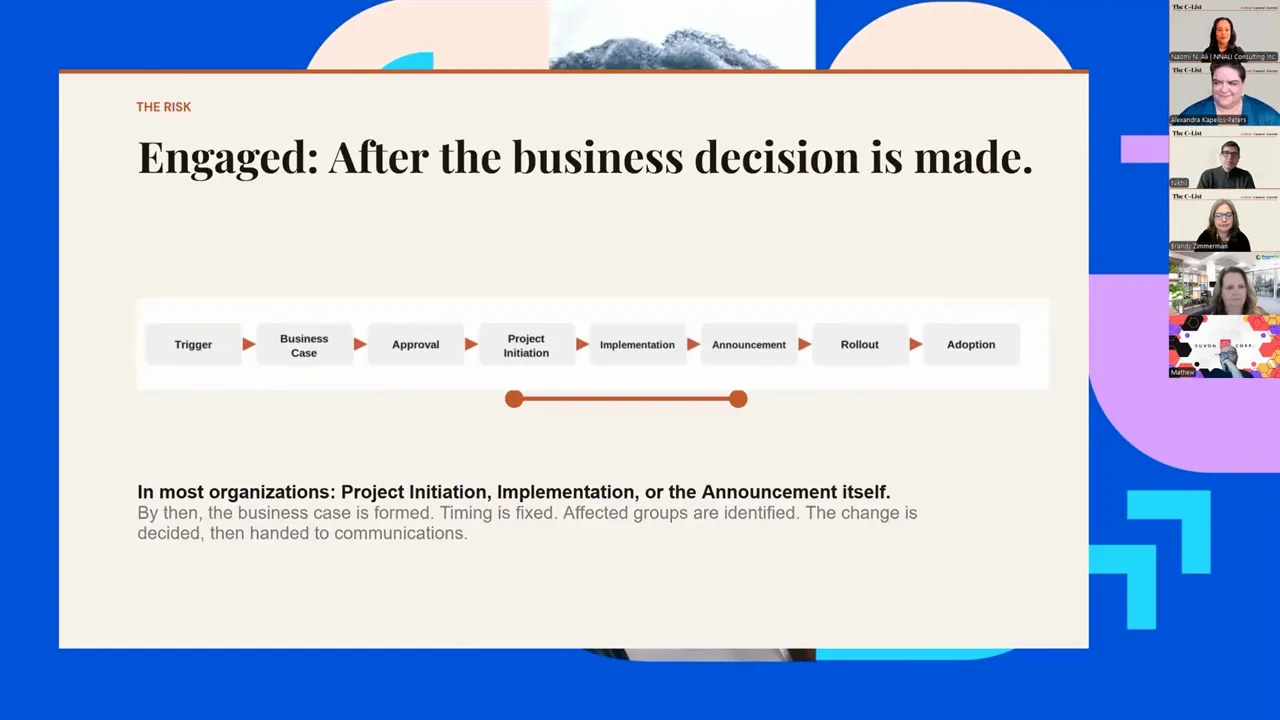
In most organizations, communications enters around project initiation or implementation planning. Sometimes that is considered early engagement, especially by project standards.
But the key point is this: the change has already been decided.
At that stage, communications is often asked to create the launch message, build the plan, and support the rollout. Those are important tasks, but they are not the same as helping shape the decision itself.
And that difference is where risk begins.
How to spot the risk early
Before we talk about solutions, we need to know what warning signs to look for. We can group them into two buckets: external and internal.
External signals
Start with historical data from previous changes.
- Reputational risk: Did past changes create external backlash or trust erosion?
- NPS trends: What happened to customer sentiment during or after earlier transformation efforts?
- Customer feedback themes: Were there complaints about confusion, inconsistency, poor timing, or broken promises?
If customers felt blindsided last time, that is not just a messaging issue. It is a strategic risk signal.
Internal signals
Then we look inward.
- Employee survey results: What do engagement scores tell us?
- Communication themes: What are people saying about clarity, trust, and leadership communication?
- Managers as communicators: Do managers feel equipped to explain change, or do they go quiet?
- HR data: What is attrition telling us, and what reasons are people giving for leaving?
- Post implementation reviews: Did the last transformation achieve its intended outcomes, and was communication actually effective?
Research has consistently shown that poor internal communication is a meaningful driver of turnover. Pay may top the list, managers matter deeply, but communication still shows up among the leading reasons people disengage or leave. For broader context on employee communication and trust, Gallup's workplace research is a useful reference point.
If we are not measuring these things at all, that is also a finding. It means the organization has an opportunity to build a more disciplined change communications consulting capability before the next major transformation starts.
Behavioral signs that something is off
Not every risk shows up in a dashboard.
Sometimes we see it in behavior:
- Executives describe the change differently
- Leaders say they should have been brought in earlier
- Managers stop communicating
- The same questions keep resurfacing after they were supposedly answered
These are often labeled as resistance. But resistance is usually not the real problem.
Resistance is the presenting problem, not the root cause
We need to think in layers.
- The presenting problem: people appear to be resisting the change.
- The underlying issue: the change is not being adopted as intended. We see gaps, rework, and stalled rollouts.
- The root cause: communication was not part of the original decision.
This distinction matters. If we only respond to visible resistance, we treat symptoms. If we want to de-risk transformation, we need to address the condition that created those symptoms.
Too often, the communications lead is asked to write the message but not to pressure test the business case. Those are very different jobs.
Change communications consulting adds value when it challenges assumptions early:
- Are we contradicting prior commitments?
- Are leaders aligned in how they describe the change?
- Do managers have the context they need?
- Will key groups interpret this as a threat, a burden, or a broken promise?
- Have we surfaced the likely downstream reactions?
That is strategic advisory work, not just message development.
The numbers behind the gap
The pattern shows up clearly in the data.
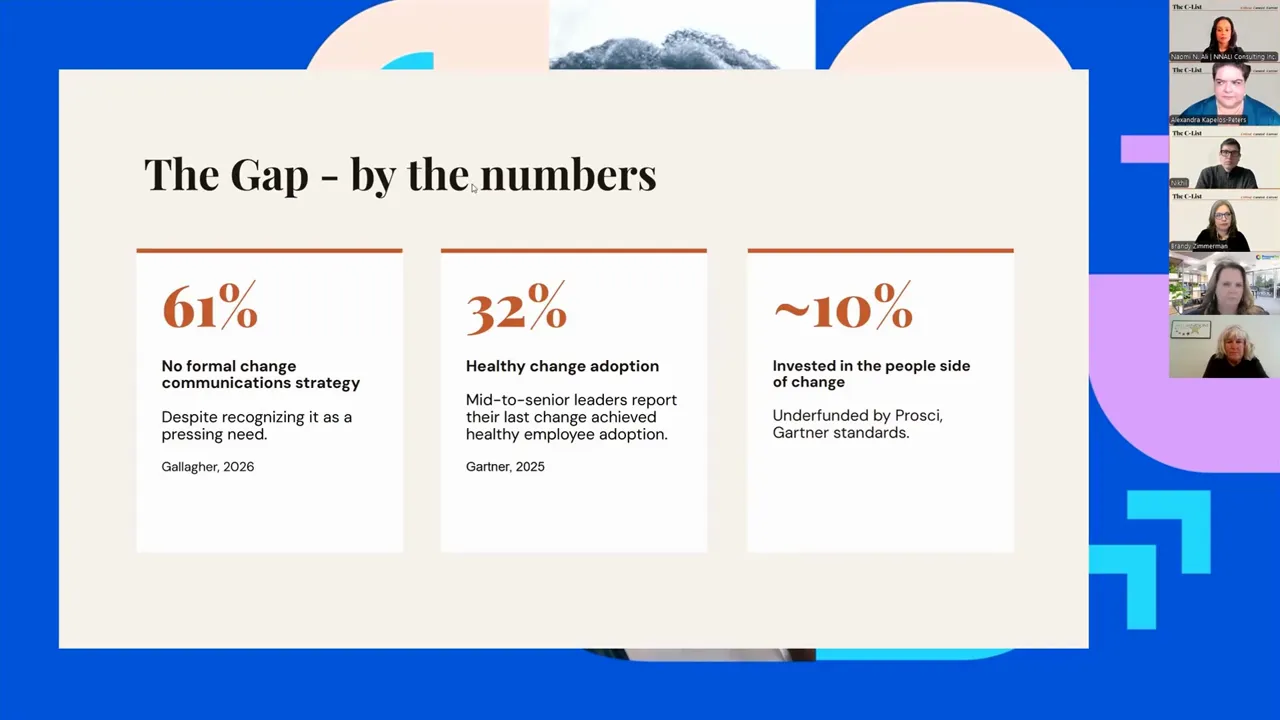
- 61% of organizations have no formal change communications approach.
- 73% of communications leaders want to operate as strategic advisors, but only 18% say they actually do.
- Only 32% of leaders say their last change achieved healthy adoption.
- Less than 10% of project budgets often goes to the people side of change, even though common guidance such as Prosci points to a stronger benchmark in the 15% to 25% range.
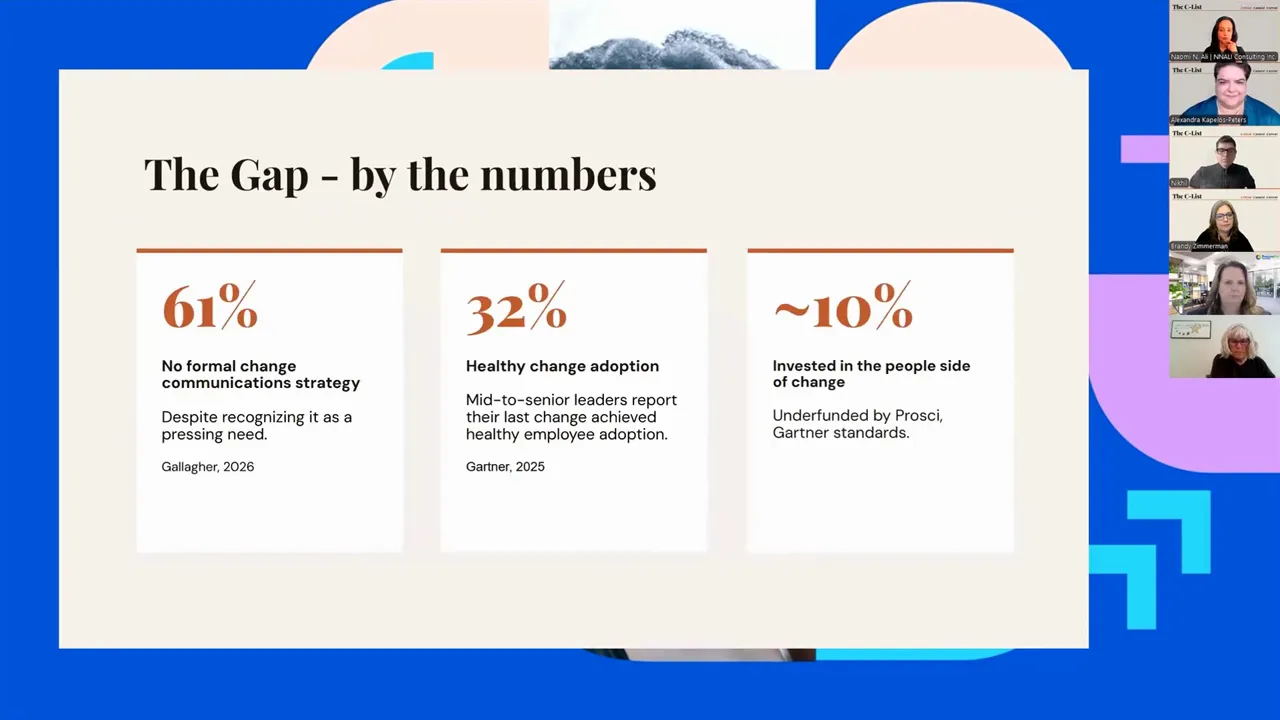
Those figures tell a consistent story. Organizations are underinvesting in the very capability that helps them translate a business decision into successful adoption.
The two risks driving change failure
We can simplify the pattern into two core risks:
- Late involvement
- Low investment
Together, they drive change failure.
Late involvement creates productivity drag because teams spend time recovering from misalignment, confusion, and unanticipated reactions.
Low investment shows up in turnover, resistance, project overruns, and the hidden cost of weak adoption.
In a mid market environment, these costs can be substantial. Even illustrative estimates quickly climb into the millions once we factor in lost productivity, employee exits, and implementation friction.
If we want to quantify our own exposure, a practical starting point is the Change Risk Diagnostic, which helps estimate readiness and the financial effect of poorly managed transitions.
The fix: bring communications in at the trigger point
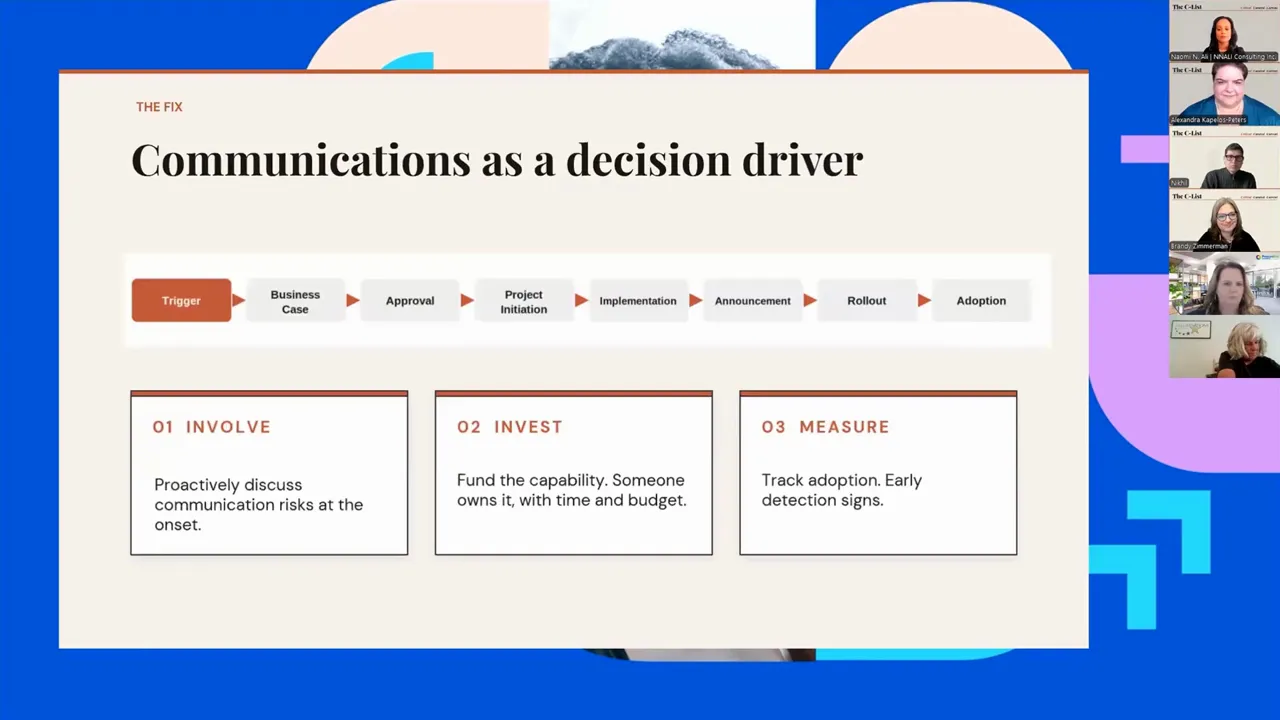
The answer is simple, even if the organizational shift is not. Communications needs a seat at the table from the trigger point onward.
That means when the issue first arrives for executive consideration, not after approval, not after kickoff, and not only when the announcement needs to be written.
We need change communications consulting at the point where the business asks, should we do this, how should we do this, and what could go wrong if we proceed this way?
Three practical action steps
- Involve communications early. Discuss communication risk alongside financial, legal, operational, and people risk before approval.
- Increase investment. Fund the capability with real ownership, time, and budget.
- Measure what matters. Track the signals that help us detect risk early and monitor adoption over time.
Organizations looking to strengthen this capability more broadly can also explore communications and marketing consulting services when in house resources are limited.
Ten questions to ask before green lighting any change
This is where change communications consulting becomes immediately useful. Before any major change is approved, we should pressure test it with questions like these.
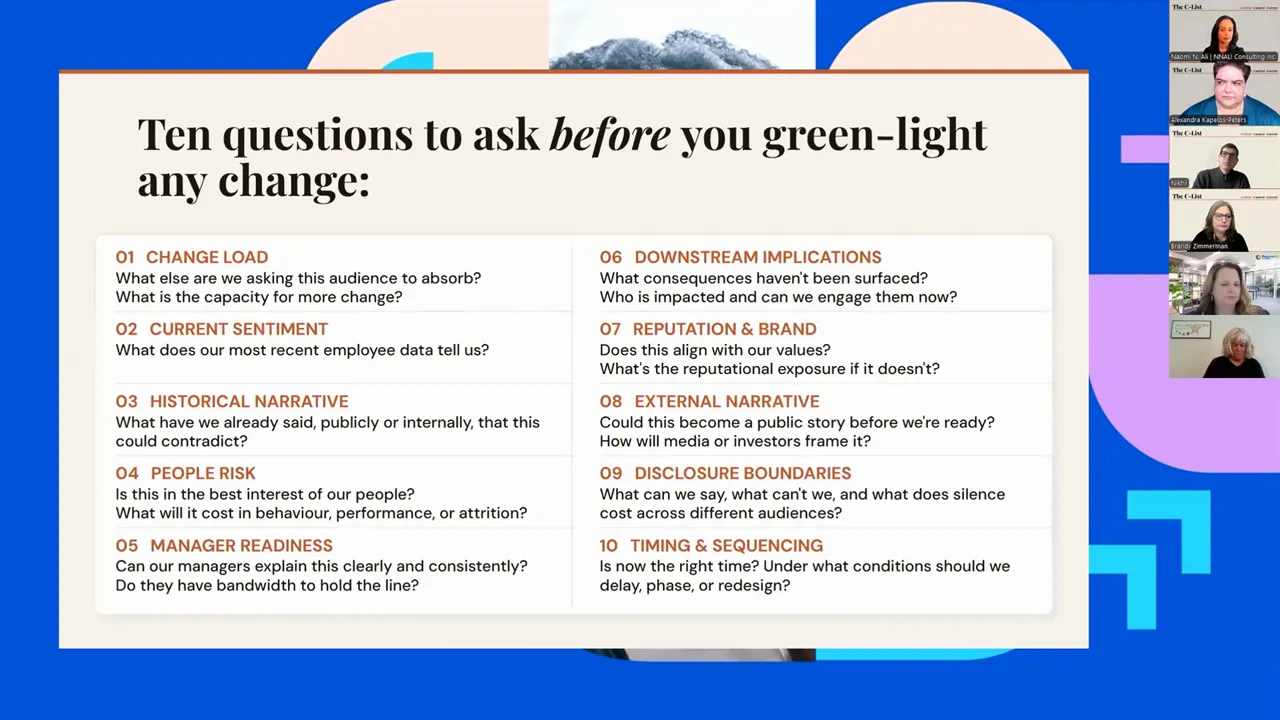
1. Change load
What else are we asking people to absorb right now? What is their real capacity for more change?
2. Current sentiment
What do the latest employee data points tell us about trust, fatigue, and engagement?
3. Historical narrative
What have we already said publicly or internally that this move could contradict?
4. People risk
Is this in the best interest of our people, and if not, what will the human cost be?
5. Manager readiness
Are managers equipped to explain the change, answer questions, and hold the line consistently?
6. Downstream implications
What consequences have not yet surfaced? Where could this create rework, confusion, or operational friction later?
7. Stakeholder impact
Who is affected, and can we engage them earlier than usual?
8. Reputation and brand
Does this decision align with our values, and could it create an external story we would rather have anticipated?
9. Disclosure boundaries
What can be shared, what must remain confidential for now, and how do we manage that tension responsibly?
10. Timing and sequencing
Is now the right time? Under what conditions should we delay, phase, or redesign the change?
These are not soft questions. They are risk questions. They belong in the same room as budget assumptions, legal review, and operational planning.
If there is no communications role, the risk still exists
Some organizations do not have a dedicated communications leader at the executive level. That does not remove the risk. It only means someone else must own it.
That ownership can sit with an internal leader who understands communication risk, or it can come from an external advisor. What matters is that somebody in the room is responsible for pressure testing the decision before it moves forward.
For organizations that need outside support, working with a specialist in change leadership and strategic communications can close that gap quickly. A relevant example is this change leadership and strategic communications profile, which focuses on leadership alignment and communication risk.
Why change communications consulting should be treated as a strategic capability
We should stop thinking of communications as the function that translates decisions after they are made.
That is like hiring an architect after the building has already been framed and then acting surprised when the structure does not hold.
Change communications consulting works best when it shapes the decision as well as the rollout. It helps us:
- anticipate resistance before it shows up
- spot contradictions before they damage trust
- align leaders before messages fragment
- prepare managers before silence spreads
- sequence change in a way people can actually absorb
- protect adoption, reputation, and productivity at the same time
If we are serious about transformation, we need to treat communication as a business capability, not a finishing step.
Additional resources
If we want to go further with change communications consulting and decision support, these resources can help:
- The C-List offers curated consulting solutions for urgent business challenges, including transformation and leadership needs.
- Change Catalyst clarity call provides a direct starting point for discussing communication risk in an upcoming initiative.
FAQ
What is change communications consulting?
Change communications consulting helps organizations reduce transformation risk by bringing communication strategy into decision making early. It goes beyond announcements and rollout plans to include risk assessment, stakeholder alignment, manager readiness, timing, and adoption planning.
Why does change communications consulting need to happen before approval?
Because once a change is approved, many of the most important risks are already baked in. Early change communications consulting allows us to pressure test assumptions, identify contradictions, assess stakeholder impact, and improve timing before the organization commits.
What are the signs that communications was brought in too late?
Common signs include leaders describing the change differently, managers going quiet, repeated questions resurfacing, weak adoption, rework, reputation concerns, and post implementation reviews that show the change did not land as intended.
How much should organizations invest in the people side of change?
Many organizations invest less than 10% of project budget in the people side of change, which is often too low. A more effective benchmark is frequently cited in the 15% to 25% range, depending on the scale and complexity of the transformation.
What if we do not have a senior communications leader?
The risk still needs an owner. If there is no dedicated internal role, an external advisor can provide the change communications consulting needed to pressure test the decision and surface communication risk before the initiative moves ahead.
Have this problem in your organization? |
|
One of our done-for-you, done-with-you, or do-it-yourself C-List solutions can help you fix it fast with a 3-4 week consulting sprint. |
| Book free Clarity Call |

