
AI pace consulting starts with a simple idea: AI only creates real value when we change how work actually runs. That is the part too many organizations skip. We rush into tools, pilots, assistants, and agents, then wonder why the bottom line barely moves.
That is exactly why we talk about pace. Not slow for the sake of slow. Better paced. Intentional. Owned. Measured. Built around real workflows instead of hype.
When we approach AI this way, we stop treating it like a bandage and start using it like an operating system upgrade for the business. That is the heart of ai pace consulting.
Table of Contents
- Why AI adoption keeps stalling
- The real cost of rushed AI projects
- Where AI is actually working
- The highest value use cases for AI
- Who should own AI inside the company
- The AI preparedness checklist
- The AI Pace sprint model
- What AI pace consulting creates
- The standard we want to set
- Additional resources
- FAQ
Why AI adoption keeps stalling
We are now several years into the generative AI boom, and the early pattern is clear. Individual use is easy. Organizational value is hard.
Almost everyone can find a quick personal use for AI. We can draft faster, search faster, summarize faster, and get immediate help on small tasks. But at the organizational level, those small wins do not automatically turn into efficiency, margin, or growth.
The reason is straightforward. AI does not create meaningful enterprise value by being sprinkled everywhere. It creates value when we rework the way decisions, workflows, data, and ownership fit together.
That is why ai pace consulting is really about setting a standard for how we adopt AI responsibly and usefully inside a company.
The real cost of rushed AI projects
One of the biggest mistakes we see is speed without structure. Organizations rush to be first, rush to show activity, or rush to say they have an AI strategy. The result is often a lot of motion with very little measurable impact.
Here are the warning signs that keep showing up across the market:
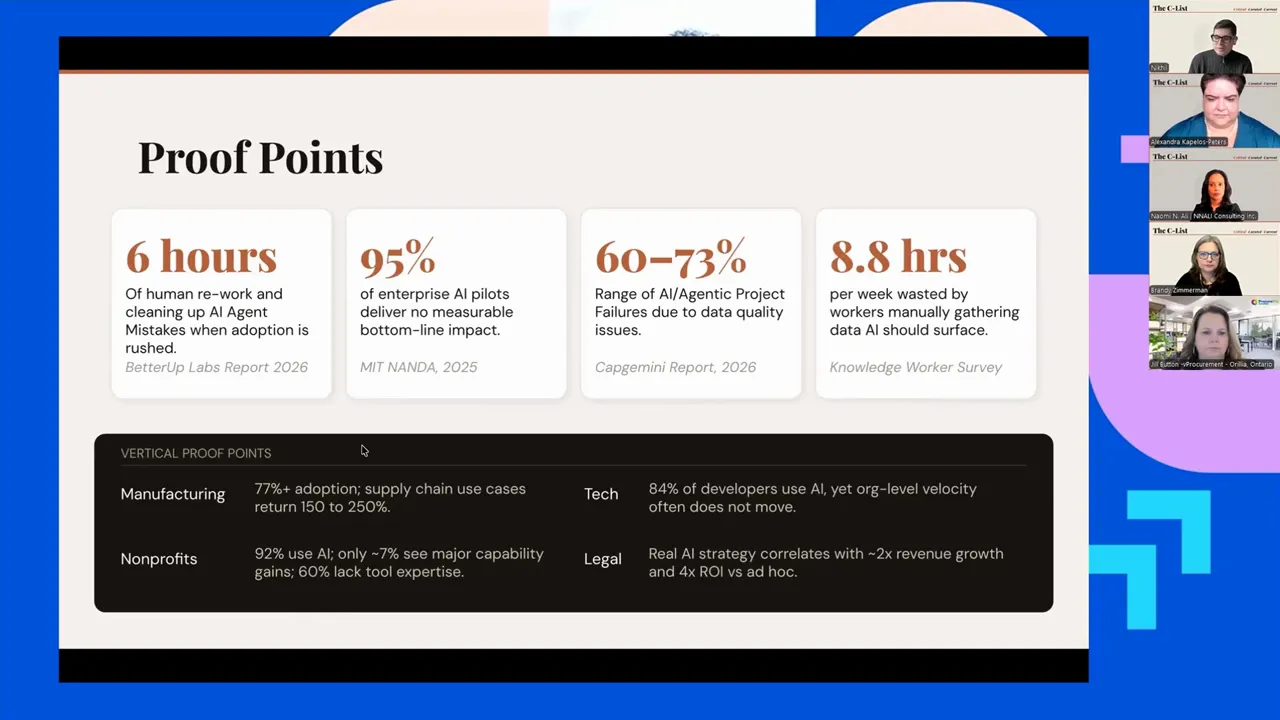
- Rework explodes. Teams spend hours cleaning up AI output instead of saving time.
- Pilots fail to affect the bottom line. Plenty of experiments never turn into measurable business gains.
- Bad data gets amplified. AI multiplies the quality of what we feed it, for better or worse.
- People still hunt for information manually. Even with AI in place, knowledge workers waste hours gathering data that should already be surfaced.
That pattern is why some organizations feel as if AI is helping and hurting at the same time. It can create instant convenience while quietly adding hidden operational drag.
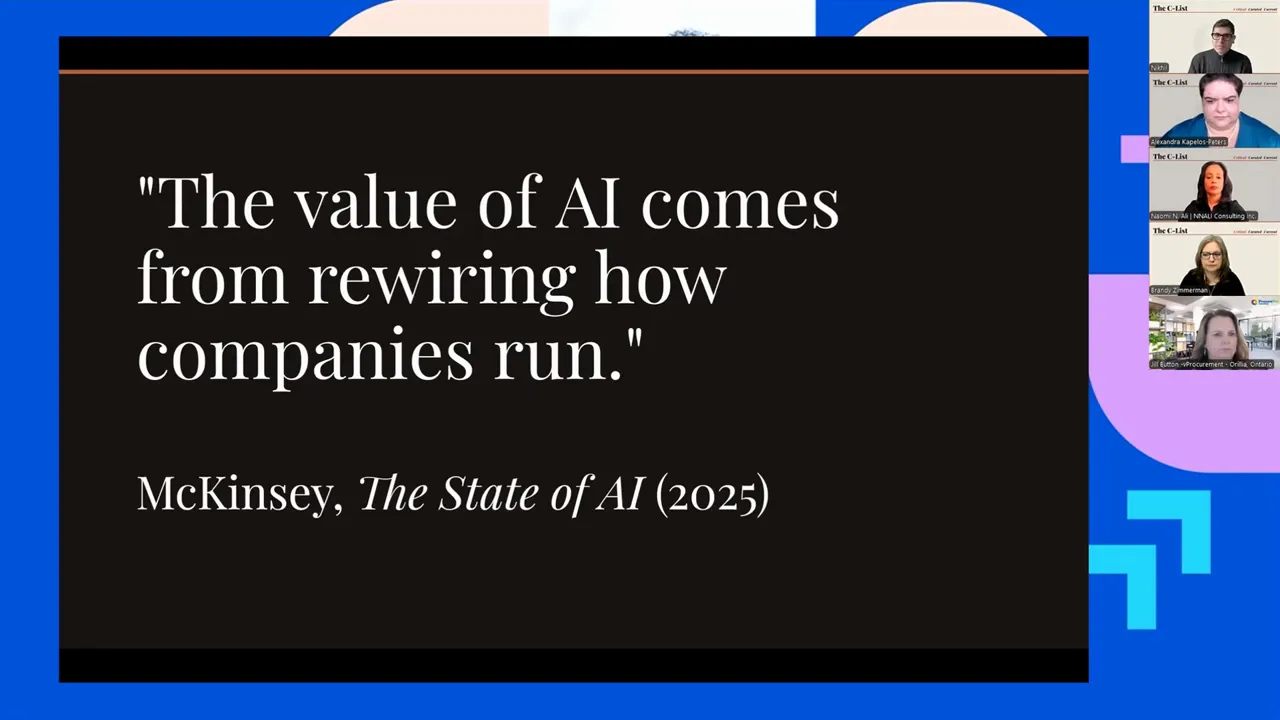
AI can multiply mistakes, not just productivity
There is an old principle that matters even more with AI: bad data in, bad data out. In practice, it is often worse than that. Bad data in, worse data out.
AI is a multiplier. If our source data is messy, inconsistent, incomplete, or poorly governed, the tool will not magically fix that. It will often scale the problem with confidence.
This is where security, governance, and quality control become non-negotiable. If a system starts inventing policy language, surfacing information it should not surface, or reinforcing broken assumptions, the damage goes far beyond wasted time.
For teams thinking about broader rollout, this connects closely with the governance and workflow redesign issues covered in why AI adoption fails without change management.
Fragmented AI gets expensive fast
Another trap is fragmentation. Different teams pick different tools, different prompts, different standards, and different owners. Soon the company is paying for overlapping capabilities while creating inconsistent outputs and duplicate effort.
And that is before we even count the baseline cost of bad data practices, which already drain organizations without any AI involved.
So when we talk about ai pace consulting, we are not only solving for innovation speed. We are solving for operational coherence.
Where AI is actually working
None of this means AI is failing everywhere. Far from it. Adoption is already strong across industries, and there are sectors where usage is widespread.
What matters is that adoption alone is not the same as effective adoption.
We are seeing real momentum in areas like manufacturing, nonprofit operations, legal work, and software-heavy environments. There are clear use cases, real benefits, and in some cases strong revenue upside. But the organizations getting those benefits are usually the ones using AI with intent.
They are not just adding tools. They are clarifying where AI fits, who owns it, how the data flows, and what metric matters.
The highest value use cases for AI
When we step back from the hype, a few use cases consistently rise to the top. These are the areas where ai pace consulting can create immediate leverage.
1. Knowledge assistance
This is the low-hanging fruit. Internal chat, search, retrieval, and question answering are often the fastest places to find value.
Examples include:
- Finding information inside shared drives or knowledge bases
- Surfacing analytics without manual digging
- Getting quick answers from internal systems
- Moving information from one tool into another with less effort
These use cases feel obvious because they usually are. But even here, data quality and access control matter.
2. Planning support
AI can be very strong at helping with sequencing, scheduling, workflow suggestions, and early-stage planning. It works best as an assistant that helps people think faster and organize better.
This is not about handing over judgment. It is about reducing friction in coordination and execution.
3. Quality intelligence
This is one of the most powerful and one of the most sensitive categories. AI can help detect inconsistencies, surface likely mistakes, and support quality review. But if the organization has poor data hygiene, the same system can learn bad patterns and reinforce them.
So quality intelligence only works well when humans stay in the loop and governance is clear.
4. Commercial operations
Support, service communication, responsiveness, and sales operations can all benefit from AI. These functions often have repetitive information work, multiple handoffs, and lots of room for speed gains.
That makes them good candidates for targeted adoption, especially when leadership wants measurable operational wins quickly.
Who should own AI inside the company
This part gets overlooked constantly. Everyone can contribute to AI adoption, but not everyone should own it.
The strongest ownership usually sits with a combination of:
- Operations, because workflows live there
- IT, because systems, access, and security live there
- Leadership, because prioritization and accountability live there
Marketing, communications, and other departments absolutely have a role. But when ownership gets too diffuse, the initiative drifts. Once thirty people are all trying to own AI together, no one really owns it.
That is why a practical roadmap matters. If you need a broader planning model, this practical AI roadmap for business is a useful companion to the ai pace consulting approach.
The AI preparedness checklist
Before we scale anything, we need a readiness test. A strong ai pace consulting engagement starts by figuring out whether the organization is actually ready to move.
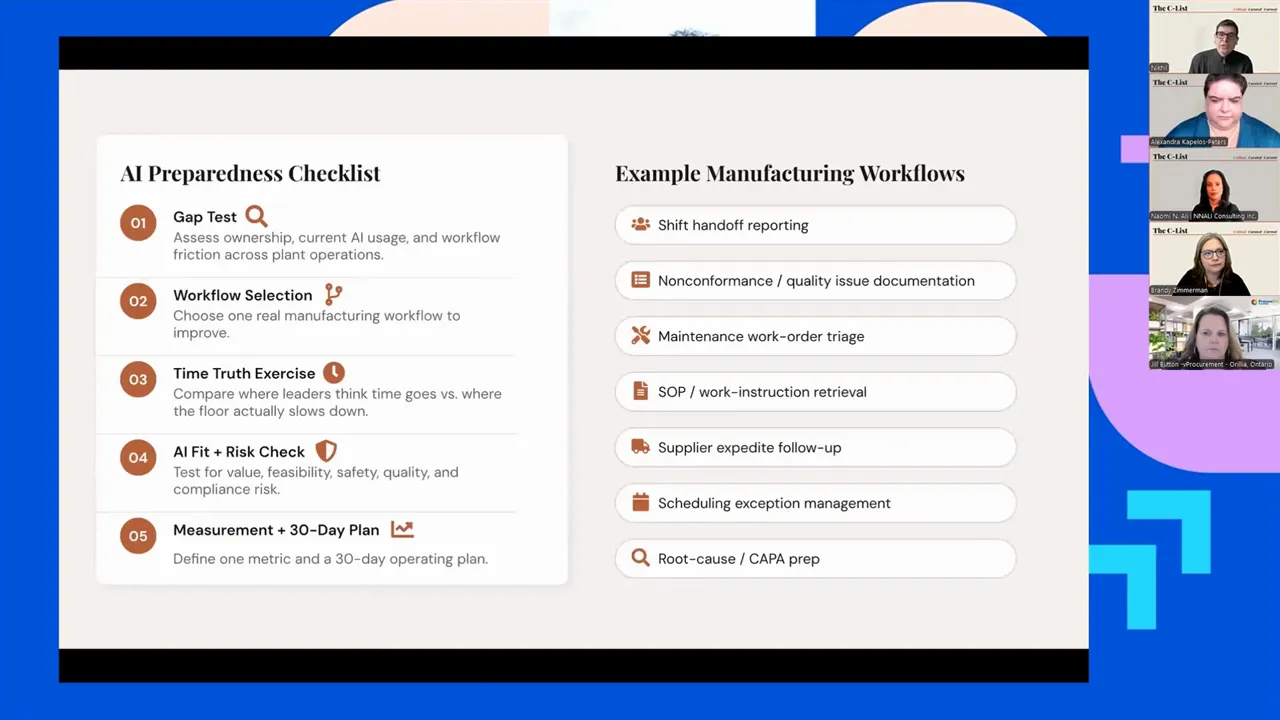
Start with a gap test
We assess the gap, but not only the gap. We also assess ownership, existing AI usage, and workflow friction.
Key questions include:
- Where is AI already being used inside the company?
- Who owns those experiments?
- Where are people already seeing hallucinations, poor outputs, or security concerns?
- Which workflows are creating friction or failing to return value?
- Are current tools helping, or are they over-engineered and adding time?
This step grounds the work in reality.
Select one real workflow
After the gap test, we choose a workflow that matters. In manufacturing, that might be things like ship handoff, supplier expediting, root cause review, schedule exceptions, or regulatory preparation.
The same logic applies in any industry. Choose one workflow, not ten. Pick something real, visible, and owned.
Run a time-truth exercise
AI promises time savings everywhere, but we need to understand where time is actually going right now.
Where are leaders spending time with decisions and data? Where are teams spending time gathering, cleaning, or reconciling information? Where are delays happening on the ground?
This step matters because it separates perceived value from actual operational drag.
Test fit, feasibility, and safety
Only after we know the workflow do we ask how AI should fit into it.
That means checking:
- Feasibility
- Data access
- Governance
- Cybersecurity alignment
- Regulatory constraints
- Role-based visibility
We want to know whether the tool supports the workflow cleanly or creates new risk.
Choose one metric and build a 30-day plan
Every workflow needs a measurable outcome. Once that is clear, we can build a 30-day operating plan around it.
This is where ai pace consulting becomes practical. We stop speaking in broad AI terms and start running a focused sprint.
The AI Pace sprint model
The sprint is where strategy meets execution. It is short enough to keep momentum and structured enough to force decisions.
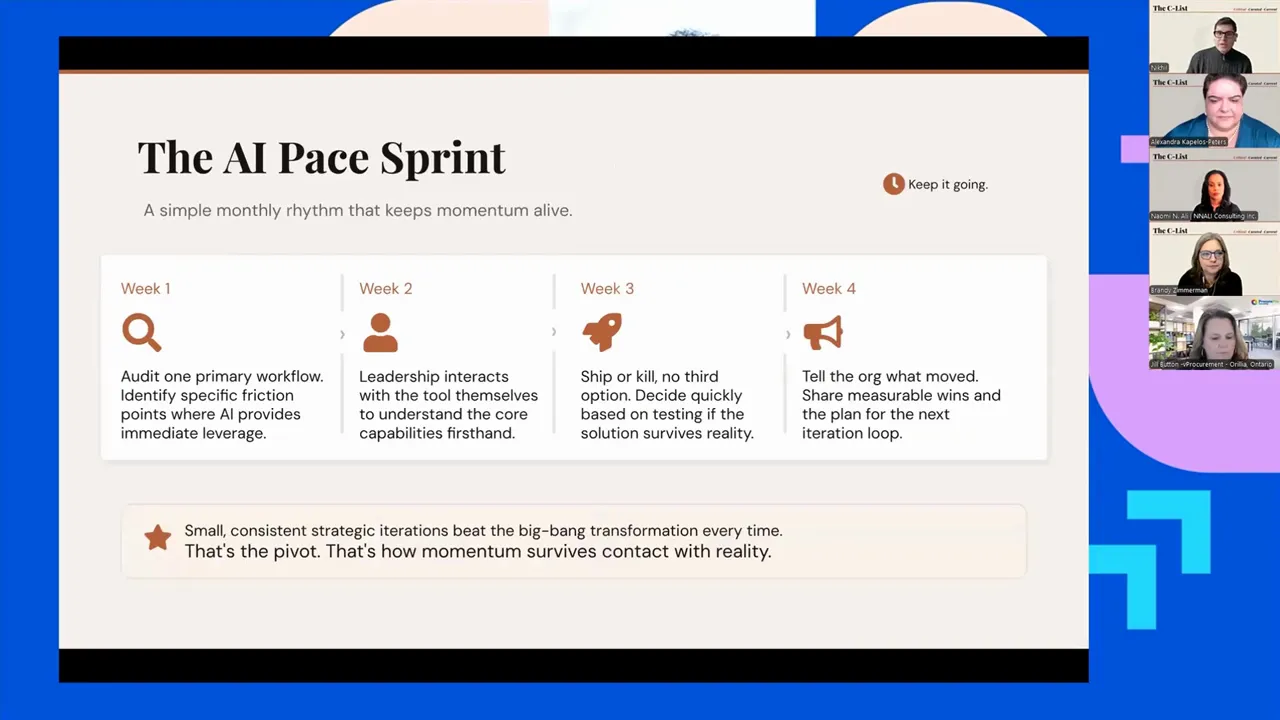
Week 1: Audit the workflow and tool connections
We start by mapping the workflow and the tools it already touches. The organization likely already has shared drives, databases, analytics platforms, communication tools, and process systems in place.
The goal is to find where AI can create immediate leverage inside that existing environment.
Week 2: Leaders and owners use the tool directly
This step is essential. The workflow owner and the relevant leaders need firsthand experience with the tool.
They need to understand:
- What it does well
- Where it fails
- What its limitations are
- What risks come with deployment
Without that capability understanding, AI adoption quickly becomes a rush job.
Week 3: Decide what to ship and what to kill
This is one of the most important parts of the model. By week three, we should have identified the strongest leverage points and the weak ones.
Some ideas should move forward. Some should be cut. Some should wait for another sprint.
That discipline matters. We do not want a vague middle zone where everything stays half alive and no one makes a call.
Week 4: Share wins and make the move visible
Once the measurable result is there, we communicate it. We share what changed, what improved, and what the organization should learn from it.
Then the sprint becomes a repeatable cycle.
This is why small, steady iteration beats a giant AI transformation project almost every time. If you want another grounded view of this kind of rollout, practical AI adoption that works on Monday is closely aligned with the same thinking.
What AI pace consulting creates
When we run adoption this way, the results get much more concrete.
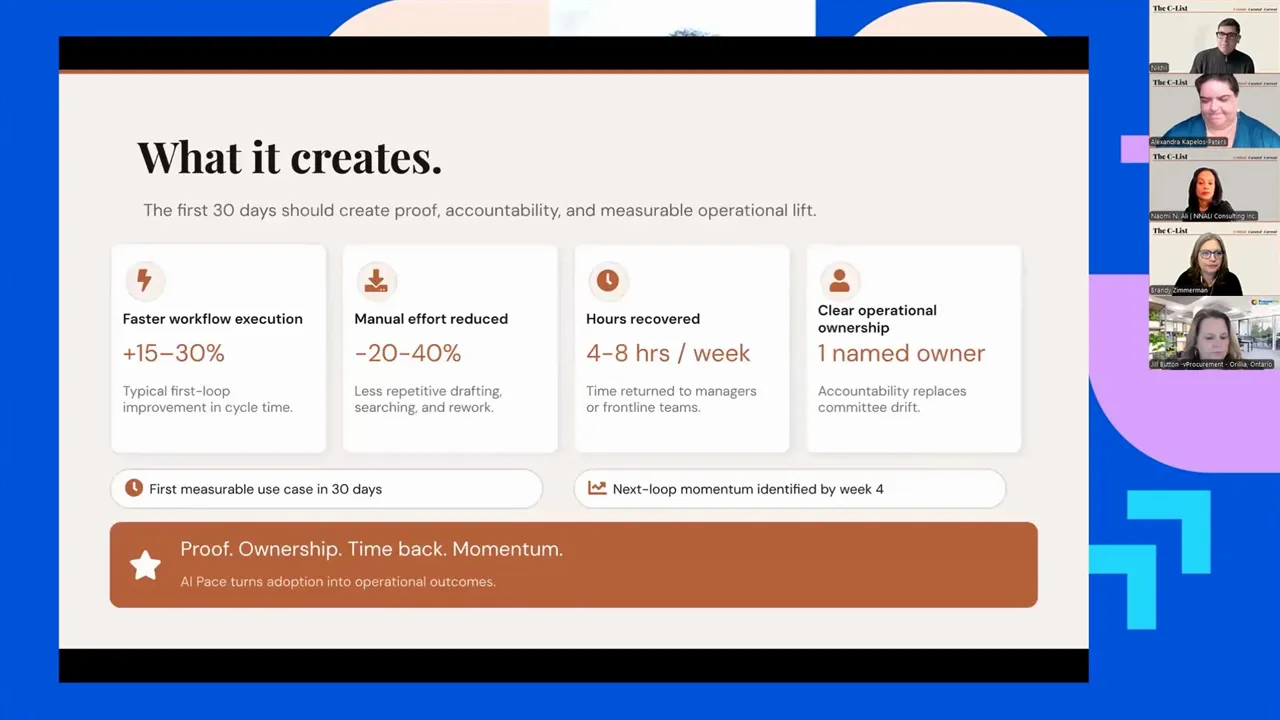
- 15% to 30% faster workflow execution in the early stage
- 20% to 40% reduction in manual effort in targeted processes
- 4 to 8 hours per week recovered for teams and leaders
- Clear ownership instead of committee drift
Those gains can expand over time, but the first objective is simpler: get to the first measurable use case in 30 days.
That early proof matters because it creates momentum. It shows the organization that AI is not just a trend or a tool to play with. It becomes a system for recovering time, improving execution, and reallocating people toward higher-value work.
The standard we want to set
The whole point of ai pace consulting is to replace reactive AI adoption with a repeatable operating standard.
We are not trying to use the most AI. We are trying to use AI well.
That means:
- Clear ownership
- Clean workflow selection
- Realistic time analysis
- Measured experimentation
- Visible decisions
- Repeatable momentum
That is the difference between chasing innovation and actually converting it into business value.
Additional resources
For organizations that want to go further with ai pace consulting, these resources can help:
- The C-List by CANSULTA for curated consulting solutions around urgent business challenges.
- AI Pace clarity call for a direct conversation about fit, ownership, and next steps.
- AI Readiness Calculator to estimate exposure, productivity upside, and alignment gaps.
- Nikhil Vimal on CANSULTA for more about the expertise behind this work.
- McKinsey's State of AI research for broader industry context on adoption and value creation.
- Capgemini research for additional perspective on enterprise AI execution challenges.
FAQ
What is ai pace consulting?
AI pace consulting is a practical approach to AI adoption that focuses on workflow redesign, ownership, data quality, safety, and measurable business value. Instead of rushing into scattered pilots, we move through focused sprints that create real operational gains.
Why do so many AI pilots fail?
Most AI pilots fail because they are disconnected from real workflows, lack a clear owner, rely on poor data, or never define a measurable business outcome. Activity gets mistaken for impact.
What are the best first use cases for AI?
The best starting points are usually knowledge assistance, planning support, quality intelligence, and commercial operations. These areas often provide fast leverage when the workflow and ownership are clear.
How long should an AI adoption sprint take?
A strong first sprint can run in 30 days. That is usually enough time to assess one workflow, validate the fit, make ship or kill decisions, and reach the first measurable use case.
Who should own AI inside the business?
Ownership should usually sit across operations, IT, and executive leadership, with one clearly accountable owner for each workflow initiative. Broad participation is helpful, but diffuse ownership creates drift.
Have this problem in your organization? |
|
One of our done-for-you, done-with-you, or do-it-yourself C-List solutions can help you fix it fast with a 3-4 week consulting sprint. |
| Book free Clarity Call |

